
Jewellery businesses need high-quality product visuals to present their designs, attract customers and support online sales. Traditionally, jewellery brands have relied on professional product photography to showcase rings, necklaces, earrings and other pieces. However, advances in 3D technology have made computer-generated jewellery visuals an increasingly useful alternative.
So, which option should your business choose: 3D jewellery rendering or real jewellery photography?
The answer depends on your product development stage, marketing requirements, available samples and visual presentation goals.
At Clipping Master Zone, we provide jewellery CAD modelling and 3D jewellery rendering services to help jewellery brands, manufacturers, retailers and designers create detailed digital product visuals. This guide explains the differences between rendering and photography and when each approach makes sense.
What Is 3D Jewellery Rendering?
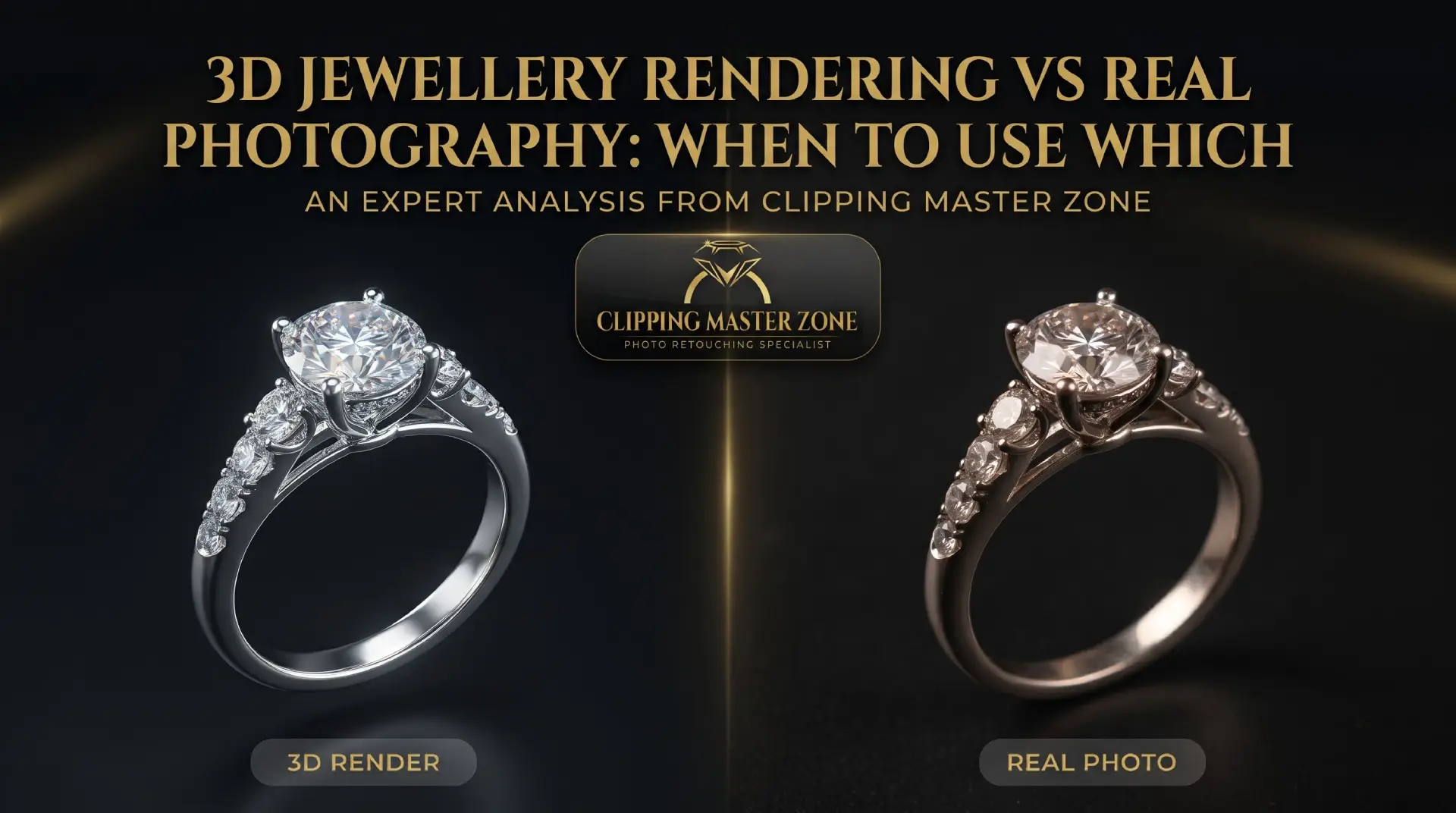
3D jewellery rendering is the process of creating realistic digital images from a three-dimensional jewellery model. A CAD model is used as the foundation, and digital materials, gemstones, lighting, reflections and backgrounds are applied to create the final visual.
A rendered image can present:
- Gold, silver and platinum finishes
- Diamonds and coloured gemstones
- Detailed prong and bezel settings
- Metal reflections and surface textures
- Multiple viewing angles
- Different design and colour variations
With professional 3D jewellery rendering services, businesses can present a jewellery design visually before a physical sample is manufactured.
Explore 3D Jewellery Rendering Services from Clipping Master Zone to learn how digital models can be transformed into realistic jewellery visuals.
What Is Real Jewellery Photography?
Real jewellery photography involves capturing images of physical jewellery pieces using a camera, suitable lighting, lenses and photography equipment.
Jewellery photographers work carefully to capture details that can be difficult to photograph, including:
- Diamond brilliance and gemstone colour
- Metal finishes and textures
- Fine engravings and decorative details
- Product proportions and physical appearance
- Reflections and natural material characteristics
Professional photography is particularly useful when a jewellery product already exists and the business wants to show the actual manufactured item.
After photography, images may also require professional retouching to improve presentation. Explore our Jewellery Photo Editing and Retouching Services for support with jewellery product images.
3D Jewellery Rendering vs Real Photography: Key Differences
Both methods can produce attractive jewellery visuals, but their workflows and applications are different.
| Comparison | 3D Jewellery Rendering | Real Jewellery Photography |
| Starting material | Digital 3D CAD model | Physical jewellery product |
| Product availability | Can be created before manufacturing if the model is ready | Requires a physical sample |
| Design changes | Digital model can be modified | Physical product may need adjustment or replacement |
| Product variations | Different finishes and gemstone options can be visualised digitally | Each physical variation generally needs to be photographed |
| Visual control | Camera angle, lighting and materials are digitally controlled | Depends on photography setup and physical product |
| Actual product representation | Shows a digital representation of the design | Shows the physical manufactured item |
| Best use | Pre-production visuals and design presentations | Actual product images and real-world details |
Neither method is automatically better in every situation. The right choice depends on what you need to communicate to your customers.
When Should You Choose 3D Jewellery Rendering?
3D jewellery rendering is particularly useful when a business needs product visuals before manufacturing or wants to explore multiple design variations.
1. Before Manufacturing a Jewellery Product
One of the biggest advantages of rendering is that you do not always need a physical jewellery sample.
Once the CAD model is ready, a digital visual can be created for design reviews, presentations and product planning.
This can be useful for jewellery manufacturers and designers developing new collections.
2. When You Need Multiple Design Variations
Imagine that your business is developing a ring in yellow gold, white gold and rose gold.
Instead of manufacturing and photographing every variation first, you can create digital versions from the CAD model.
Rendering can help present different:
- Metal colours
- Gemstone combinations
- Diamond arrangements
- Setting styles
- Design variations
The final physical product should still be checked to ensure that its appearance matches the approved design.
3. For Jewellery Catalogues and Product Presentations
Digital renders can be used in product catalogues, collection previews, presentations and online product pages.
They help businesses maintain a consistent visual style across different jewellery designs.
4. For Custom Jewellery Concepts
Customers may want to see a personalised ring, pendant or necklace before approving production.
A detailed 3D model and rendered view can help communicate the proposed design and make it easier to discuss changes.
5. When Physical Samples Are Not Yet Available
New jewellery collections may take time to manufacture. Rendering allows businesses to prepare digital presentations while products are still in development.
However, businesses should clearly distinguish digital concept visuals from photographs of finished products.
When Should You Choose Real Jewellery Photography?
Although rendering offers flexibility, real product photography remains essential for many jewellery businesses.
1. When You Need to Show the Actual Product
If a jewellery piece has already been manufactured, photography shows the physical item rather than a digital interpretation.
This is especially important when customers want to inspect the actual product’s finish, proportions and visible details.
2. When Showing Natural Gemstone Characteristics
Real gemstones may have individual variations in colour, inclusions and light behaviour.
Photography can document the actual gemstone used in a particular product. This is valuable when the exact stone matters to the buyer.
3. For E-Commerce Product Listings
Online shoppers often want to see the item they are purchasing from several angles.
Professional product photography can show the physical jewellery piece and help customers understand its appearance.
For additional image preparation, businesses can use professional Jewellery Background Removal Services and Jewellery Colour Correction Services.
4. For Lifestyle and Model Photography
Real photography is useful when jewellery needs to be shown being worn by a model or styled in a real environment.
These images can communicate scale, styling and how a piece looks when worn.
5. When Accurate Physical Details Matter
If customers need to inspect the actual surface finish, small manufacturing marks or physical characteristics, photography provides a direct record of the product.
Can Jewellery Businesses Use Both Rendering and Photography?
Yes. In many cases, combining both methods creates a more complete product presentation.
For example, a jewellery business launching a new collection could use:
- 3D jewellery rendering for pre-launch previews and design variations.
- Real product photography for finished jewellery pieces.
- Jewellery photo retouching to improve the final photographs.
- Different product views to help customers understand the design.
A manufacturer might use CAD models and renders during product development, then photograph the finished jewellery after production.
This approach allows businesses to benefit from the flexibility of digital visuals while still showing customers the actual manufactured product.
How 3D CAD Design Supports Jewellery Rendering
Professional rendering begins with a suitable digital model. The CAD design provides the geometry and structure needed to create the final image.
The typical workflow includes:
- Reviewing the jewellery sketch or design reference.
- Creating the digital 3D jewellery model.
- Refining the proportions and gemstone settings.
- Applying suitable metal and gemstone materials.
- Setting up digital lighting and camera angles.
- Producing and reviewing the final rendered images.
For custom designs, professional Jewellery CAD Design Services can help convert a concept into a digital model.
Clipping Master Zone also supports specific design requirements through Ring CAD Design, Pendant CAD Design and Earring CAD Design services.
How Clipping Master Zone Helps Jewellery Businesses
At Clipping Master Zone, we support jewellery businesses with CAD modelling and digital visualisation services for different types of jewellery products.
Our 3D jewellery rendering services are suitable for:
- Jewellery manufacturers
- Jewellery brands and retailers
- Independent jewellery designers
- E-commerce jewellery businesses
- Custom jewellery businesses
- Companies developing new collections
Our jewellery CAD and rendering support includes:
- 3D jewellery CAD modelling
- Realistic jewellery rendering
- Ring, pendant and earring designs
- Diamond and gemstone visualisation
- Metal finish variations
- Design modifications and digital presentations
We primarily target jewellery businesses in the UK, USA and Romania while serving clients worldwide.
If you have a jewellery sketch, CAD model or reference image, you can contact Clipping Master Zone to discuss your project requirements.
Which Is Better for Your Jewellery Business: Rendering or Photography?
The best choice depends on your business requirements.
Choose 3D jewellery rendering when you need to visualise designs before manufacturing, create digital variations or prepare product presentations from CAD models.
Choose real jewellery photography when you need to show an existing physical product, document actual gemstone characteristics or create lifestyle images.
Choose both when you want to present a jewellery collection through digital previews and photographs of finished products.
For many modern jewellery businesses, these methods work together rather than competing with each other.
Frequently Asked Questions About 3D Jewellery Rendering and Photography
What is the difference between 3D jewellery rendering and real jewellery photography?
3D jewellery rendering creates digital images from a CAD model using virtual materials and lighting. Real jewellery photography captures an existing physical jewellery product using a camera and photography equipment.
Is 3D jewellery rendering cheaper than professional jewellery photography?
The overall cost depends on the project, design complexity, number of images, required variations and production requirements. Rendering may reduce the need to manufacture physical samples for certain visual presentations, but it is not automatically cheaper for every project.
Can 3D jewellery rendering look like real photography?
Yes. Professional rendering can create highly realistic visuals using detailed models, accurate materials, gemstone effects and carefully controlled lighting. However, a render remains a digital representation rather than a photograph of the actual manufactured product.
Do I need a CAD model for 3D jewellery rendering?
A suitable 3D model is generally required. If you only have a sketch or reference image, a CAD modelling stage may be needed before rendering can begin.
Can I use 3D jewellery renders for e-commerce websites?
Yes. Businesses can use rendered images for product presentations and e-commerce listings where the platform’s policies and applicable advertising rules permit them. Digital visuals should accurately represent the product being offered.
Can jewellery rendering show different gold colours and gemstones?
Yes. A digital model can be rendered with different metal finishes and gemstone combinations. These variations help businesses visualise design options before manufacturing, although the final physical product may differ in appearance.
Does Clipping Master Zone provide 3D jewellery rendering services in the UK?
Yes. Clipping Master Zone provides jewellery CAD modelling and 3D rendering support for UK jewellery businesses, including manufacturers, retailers, brands and independent designers. We also serve clients worldwide.
Final Thoughts
3D jewellery rendering and real jewellery photography serve different purposes. Rendering is useful for design development, digital previews and product variations, while photography is important for showing actual manufactured jewellery and its physical characteristics.
By understanding when to use each method, jewellery businesses can create more effective product presentations and support their design and marketing workflows.
For professional 3D jewellery rendering services, Clipping Master Zone helps jewellery businesses transform CAD models into detailed digital visuals. Contact our team to discuss your next jewellery rendering project.